Readings:
Isaiah 11:1-10
Psalm 72:1-2, 7-8, 12-13, 17
Romans 15:4-9
Matthew 3:1-12
Seventy years ago, prophetic words flowed from Montgomery, Alabama: “But I want to tell you this evening that it is not enough for us to talk about love. Love is one of the pivotal points of the Christian faith. There is another side called justice. And justice is really love in calculation. Justice is love correcting that which revolts against love.”
Rev. Dr. Martin Luther King, Jr. preached these words on Dec 5th, 1955. He was 26 years old and still getting settled into the city with his wife Coretta and their baby daughter, Yolanda. In addition, this new father was finishing his doctoral dissertation while learning how to pastor Dexter Avenue Baptist Church. Earlier that day, he reluctantly accepted the presidency of the newly formed Montgomery Improvement Association which was organizing a bus boycott.
This year, the Second Sunday of Advent coincides with the 70th anniversary of the beginning of the Montgomery Bus Boycott that lasted 381 days. And this week’s readings are relevant for understanding 1955 as well as for prophetic living in 2025.
Matthew’s Gospel portrays John the Baptist as a fiery prophet in the desert whose ministry is preparing the way for the Messiah and God’s Spirit. To us Christians, John’s words–“Repent, for the kingdom of heaven is at hand!”—signify a faithful response to the renewed dwelling of God’s Spirit—God’s kingdom—among us here on earth. John called on all who heard his words to change their way of life immediately and, in the words of the prophet Micah, “to do justice and to love goodness, and to walk humbly with your God” (6:8). And John’s baptism of repentance was a sign of this change in lifestyle.
Paul’s Letter to the Romans reminds us that, as God’s Spirit approaches, boundary transgressions occur and new, hybrid, identities emerge. He asserts that the salvation from the covenant could now be extended to the Gentiles without requiring them to convert first to Judaism. And this could occur through a new movement, a hybrid movement from the peripheries, that eventually would be called Christianity.
Of course, the Prophet Isaiah provides the vision for all of this in the details of a land ruled by a righteous King from the line of David who will be saturated with God’s Wisdom and bring about an era of Shalom. And, in the midst of the Baptist’s calls to repent from sinning Paul’s exhortation to recognize and embrace the new work God is doing, and Isaiah’s radical vision of shalom, the Psalmist reminds us of the essence of this new world to be birthed: “Justice shall flourish…and [the] fullness of peace forever.”
In 1955, a young Rev. King accepted the calling from his community to a public ministry of liberation and justice. Similar to the readings, his ministry was rooted in justice and love and oriented towards the goal of peace. His words from seventy years ago help mediate God’s Spirit imbued in this week’s readings to us here and now in 2025.
For we, too, live in contexts saturated with violence and injustice. Even in the U.S. Whether it is the federally orchestrated abductions and imprisonment of our migrant brothers and sisters; the coordinated attacks upon the webs of diversity that make known the Triune God’s promise of human dignity and the common good in this life; the attempted whitewashing of the United States’ “original sins” of genocide, slavery, and racism due to the fear that the truth will indeed set us all free; or the normalization of cruelty and dehumanization towards any person or group considered “other”; our context shows resonance with the contexts of Scripture thousands of years ago. Or Montgomery, Alabama seventy years ago.
As we prepare for the arrival of Emmanuel, the “dangerous memories” from Montgomery and from Scripture call us to do an internal inventory of our communities, our Church, and ourselves. To use the words of Gustavo Gutierrez, are we centering repentance from serving idols of death and a re-commitment to serving the God of Life and Liberation in our daily lives? Do we truly embody the truth that love and justice are fully interrelated and will bring about peace? Do we demonstrate with our lives that: “Justice is love correcting that which revolts against love?” Let us ponder these questions in our hearts throughout this second week of Advent. Amen.
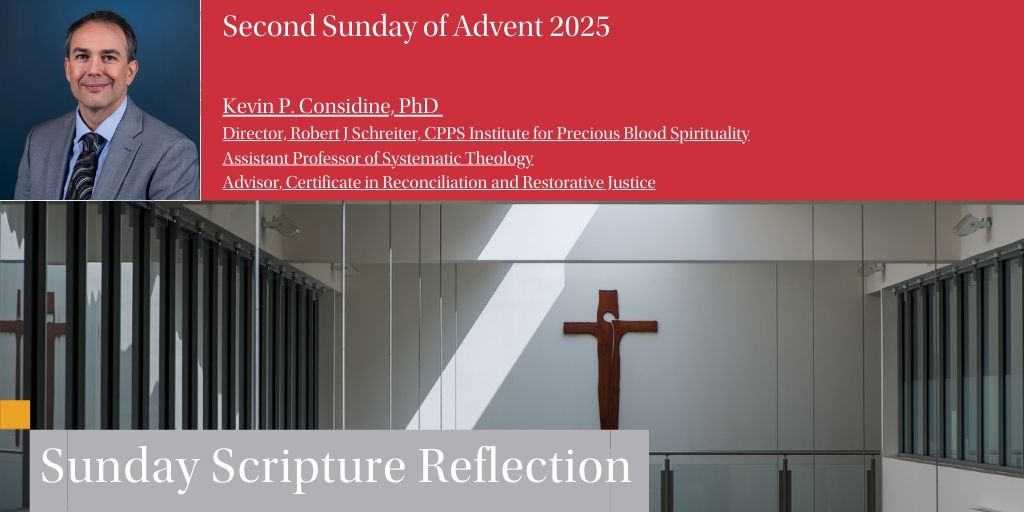
Kevin P. Considine, PhD
Director, Robert J Schreiter, CPPS Institute for Precious Blood Spirituality
Assistant Professor of Systematic Theology
Advisor, Certificate in Reconciliation and Restorative Justice