
Readings:
1 Kings 3:5, 7-12
Psalm 119:57, 72, 76-77, 127-128, 129-130
Romans 8:28-30
Matthew 13:44-52
As I reflected on the Gospel for the Seventeenth Sunday in Ordinary Time, I found myself remembering the words of one of my favorite bands, U2. Bono sings:
“I have climbed highest mountains,
I have run through the fields…
But I still haven’t found what I’m looking for.”
Those lyrics have resonated with millions because they express something profoundly human. We spend our lives searching. We search for happiness, love, security, purpose, and peace. We climb mountains of achievement, run through the fields of ambition, and yet there remains within us a longing that nothing in this world can fully satisfy.
Jesus’ parables this Sunday begin precisely at that point. But they also offer an unexpected answer. They tell us not simply about people searching, but about people who finally find. Jesus tells us of two people who discover something so valuable that they gladly sell everything to possess it. The Kingdom of God is not primarily something we build or achieve. It is first something we discover. Like the treasure hidden in the field, God’s life is already present, often concealed beneath the ordinary soil of our lives. The Gospel is not only the story of our search for God; it is first the story of God’s search for us.
Most of us naturally identify with the man who finds the treasure. We think of ourselves as the ones who must give up everything to follow Christ. That is certainly true. Once we truly encounter him, everything else loses its absolute importance.
But the parable invites us to look even deeper. What if the one who sells everything is first of all Jesus himself?
He emptied himself, entered our fragile humanity, and embraced the Cross because he saw a treasure hidden in the field of this world. That treasure is us. Beneath our sin and brokenness, he sees the beauty the Father has always seen. He was willing to pay the highest price—his own life—to claim what he loves.
This changes everything. Christianity does not begin with our sacrifice for God. It begins with God’s sacrifice for us. Before we ever gave anything to him, he gave everything for us.
Notice something beautiful in the first parable. The man does not sell everything reluctantly. Jesus says that “out of joy” he goes and sells all that he has to buy the field. If that man is also an image of Christ, then it is with immeasurable joy that he gives everything to make us his own. The Cross is not simply the price he paid; it is the measure of the joy and love with which he sought us. As the Letter to the Hebrews tells us, “for the joy that was set before him, he endured the cross” (Heb 12:2). We are the treasure for which he willingly gave everything. We are the joy set before him.
For this reason no human life can ever be called worthless.
The world measures people by success, possessions, achievements, or failures. Christ has already measured our worth by the price he was willing to pay. That dignity cannot be earned, and it cannot be taken away. No border can erase it. No prison can imprison it. No age can diminish it. Whenever we look into another person’s face, we are looking at someone Christ considered priceless.
The Gospel concludes with the image of the great net gathering fish of every kind. It is a striking image of the Church and of God’s own heart. Before there is any separation, there is first an astonishing gathering. The net is cast into the sea without discrimination. It gathers fish of every kind because God’s invitation is offered to every person. The emphasis falls first not on the sorting but on the gathering. God’s first movement is always mercy before judgment, invitation before separation.
That is why Jesus does not tell the disciples to sort the fish. The separation belongs to the angels at the end of the age, not to us in the present. St. Augustine, writing against the Donatists who wanted a Church made up only of the visibly pure, reminds us:”Many who seem to be outside are within, and many who seem to be within are outside” (Exposition on Psalm106 [107], §14; cf. On Baptism, Against the Donatists V.27.38). Only God sees the heart. Our task is not to determine who belongs in the net, but to keep casting it — to proclaim the Gospel, to welcome, to accompany, and to trust God’s justice and mercy.
The Church is not a society of the perfect but a community of sinners continually being transformed by grace. We do not evangelize because people have already become worthy; we evangelize because Christ has already declared them worthy of his love.
At every Mass, Christ continues to give himself completely because he still sees his treasure before him. He never tires of seeking us, feeding us, forgiving us, and drawing us more deeply into his life.
Perhaps Bono’s lyrics resonate so deeply because they give voice to the longing that lives in every human heart: “I still haven’t found what I’m looking for.” The Gospel assures us that our deepest longing is not an illusion. We were made for the Treasure that alone can satisfy the human heart. Yet the greater wonder is that, long before we began searching for him, Christ had already come searching for us. He found us hidden beneath the soil of our weakness and sin, saw in us the beauty the Father had always seen, and, with joy, gave everything to make us his own.
May we ask, like Solomon, for a wise and listening heart, so that we may finally find what we have been looking for all our lives: Christ, who first found us, revealed to us the beauty he had always seen in us, and invites us into the joy of belonging to him forever.
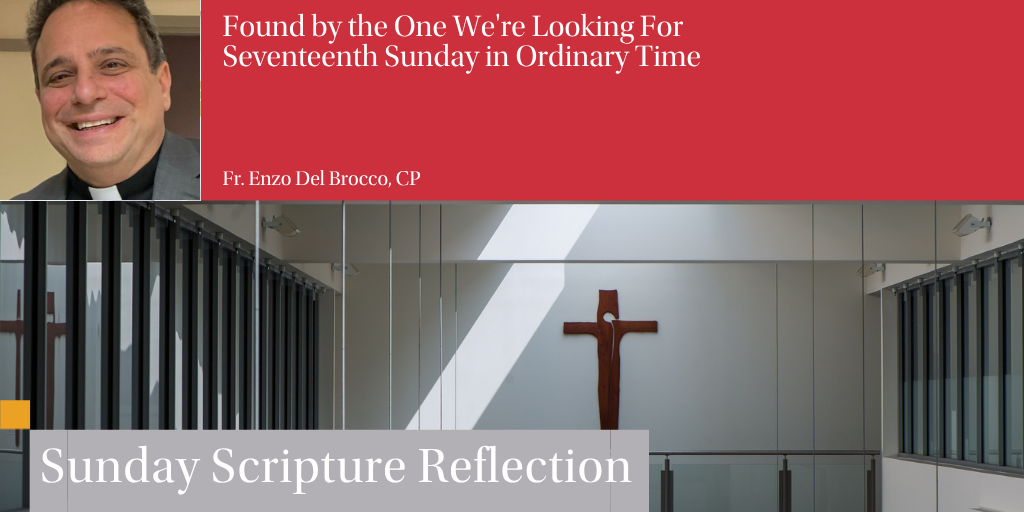
Fr. Enzo Del Brocco, CP